The AI-native archive platform

AI for archives and heritage collections.

The archive is bigger than the catalogue.

AI drafts ISAD(G)- and Spectrum-aligned records, an archivist accepts every field, and it exports into the repository you already run.

30 free credits a month · No card needed

Works with the systems you already run

How it works

From box to public catalogue in days, not decades.

Three steps, one review gate. Archivers.ai sits between digitisation and the system of record you already run.

Step one of the Archivers.ai accession wizard, Describe Collection, with a free-text description box and optional panels for archival context, donor and provenance, completeness and scope, and collection assignment
3 credits · cost shown before you commit
Step one

Upload a box, describe it once.

Drag in scans, photograph items with a phone, or bulk-upload a digitised backlog.

  • Documents, photographs, objects, audio, video
  • Collection context sharpens the first draft
  • Credit cost shown before you commit
See the full workflow
An Archivers.ai record awaiting review: a personal-data flag, an expandable AI evidence panel explaining how the date and location were inferred, and evidence marks against the drafted title, date, creator and description
creator · no direct evidence · reviewEvidence cited from the page, field by field
Step two

AI drafts. You decide.

Every field cites its evidence, or is flagged as having none. Nothing lands unreviewed.
  • Evidence cited field by field, with personal data flagged
  • Personal data and sensitivity flagged early
  • A human accept before anything exports
How we use AI
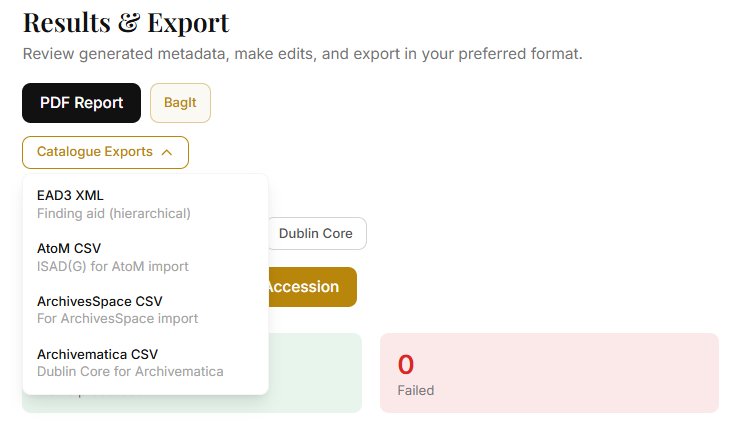
The Archivers.ai Results and Export screen with the catalogue exports menu open, listing EAD3 XML finding aids, AtoM CSV, ArchivesSpace CSV and Archivematica CSV alongside PDF report, BagIt and Dublin Core
EAD3 · AtoM CSV · ArchivesSpace CSV
Step three

Export into what you already run.

Reviewed records leave as open standards, or publish straight to a public access portal.

  • EAD3, BagIt with PREMIS, Dublin Core
  • AtoM, ArchivesSpace and Spectrum CSV
  • Public access portal on paid plans
All export formats
What it costs

Published, to the penny.

£3–£5

Typical manual cataloguing cost per item

From 6p

Per credit on the largest credit packs

30

Credits a month on the free Community plan

Free

Volunteer and reviewer seats on every paid plan

One credit catalogues one photograph or object, one document page, one minute of video, or five minutes of audio. See plans and credits

Who it’s for

Four routes through one platform.

The same review gate and the same exports, sized to how your service works.

Archivists

ISAD(G) drafts, EAD3 out, and a review gate on every field.

Museums

Spectrum-aligned object records for Axiell, Modes, Adlib and Mimsy.

Community archives

A free plan, volunteer seats and a public portal, with no IT department.

Directors

Published prices, EU-resident AI, and a pilot before anything is signed.

From the sector

What archivists tell us.

“There’s either you use something like CALM or you use Excel. There’s nothing really in the middle — and I think this sits in the middle quite nicely.”
A county archivist, on where Archivers.ai fits Why CALM services move

EU-resident AI processing

Data processing agreement published

Human review on every field

Every price published

AI for archives

What AI does in an archive, and what it leaves to you.

AI for archives is not a magic box. It is extra capacity for the slow first pass — reading, transcribing and drafting — so archivists and curators spend their time on judgement.

Reading the page

OCR and handwriting

Typed pages, printed forms and handwritten registers are read and transcribed. Every word carries a confidence score, and the words the AI is unsure of are marked for a person to settle.

Listening and watching

audio and video

Oral histories, recordings and film are transcribed and described on paid plans, so what they contain becomes searchable text rather than a title on a shelf list.

Drafting the description

metadata generation

From the transcript and the images, the AI drafts the catalogue record: title, dates, creator, scope and content, and the people, places and subjects that become access points. Drafts map to ISAD(G) for archives and Spectrum for museum objects.

Showing its working

evidence and provenance

Each field cites the evidence it was drawn from, or says it has none. Provenance for AI-assisted fields — model, timestamp and review state — is recorded and leaves with the export as PREMIS events.

Flagging what needs care

sensitivity and personal data

Personal data and potentially sensitive content are flagged before anything is published, so closure and redaction decisions are made by someone with the context to make them.

Making it findable

search and public access

Full-text search runs across records and transcripts. Reviewed records publish to a public access portal, or export to AtoM, ArchivesSpace, Axiell and the other systems you already run.

What stays with you

professional judgement

Appraisal, arrangement, closure periods and the final wording are professional decisions. AI can also repeat outdated or biased language from its sources. That is why nothing leaves Archivers.ai until a person has accepted it, field by field.

Getting your archive ready for AI? The Archives and Records Association’s AI Preparedness Guidelines for Archivists are a good place to start, and our practical guide to preparing your archive covers the first steps. How we use AI

Common questions

AI for archives, answered.

How can AI be used in archives?
To take on the first pass of cataloguing: reading and transcribing documents, describing photographs and objects, transcribing audio and video, and drafting standards-aligned catalogue records. In Archivers.ai every drafted field is reviewed and accepted by a person before it is exported or published.
Will AI take archivists’ jobs?
No. It adds capacity for archives that will never have enough hands. The AI drafts; the archivist decides. Appraisal, arrangement, sensitivity and the final wording stay with people.
How accurate is AI cataloguing?
No AI is right every time, so Archivers.ai shows its working. Each field cites its evidence or is flagged as having none, transcripts are scored word by word, and nothing is exported until a person has accepted it.
Is our collection data used to train AI models?
AI processing runs in EU data centres. Customer collection data is not used to train foundation AI models; we follow vendor no-training commitments — see Trust.
Does it work with the collections system we already run?
Yes. Reviewed records export as EAD3, Dublin Core and BagIt with PREMIS, plus import CSVs for AtoM, ArchivesSpace and Archivematica. Museum records map to Spectrum for Axiell, Modes, Adlib and Mimsy. All export formats
Can we use it on a funded digitisation project?
Yes. Archivers.ai is designed to support NLHF-style digitisation workflows, and helps teams produce standards-aligned outputs for funded digitisation projects. Heritage funding
What does AI cataloguing cost?
Every price is published. The Community plan is free with 30 credits a month; paid plans start at £40 a month, or £32 a month billed annually, excluding VAT. One credit catalogues one photograph or object, one document page, one minute of video, or five minutes of audio. See plans and credits

Catalogue the backlog. Publish the collection.

Start free with 30 credits a month, or talk to us about an institutional pilot.